
Orange Bear Lawn Care
A seasonal landscaping business with data-driven Google Ads and a strong web presence: 150+ leads per month and a 5.8× ROAS.
Measurable Results
The Challenge
Orange Bear Lawn Care runs a highly seasonal business: in Vancouver, demand between March and October swings by a factor of five. The old site was static and communicated no seasonal logic, and the first Google Ads campaigns ran without seasonal pacing — expensive in peak, inefficient in the off-season.
Our Solution
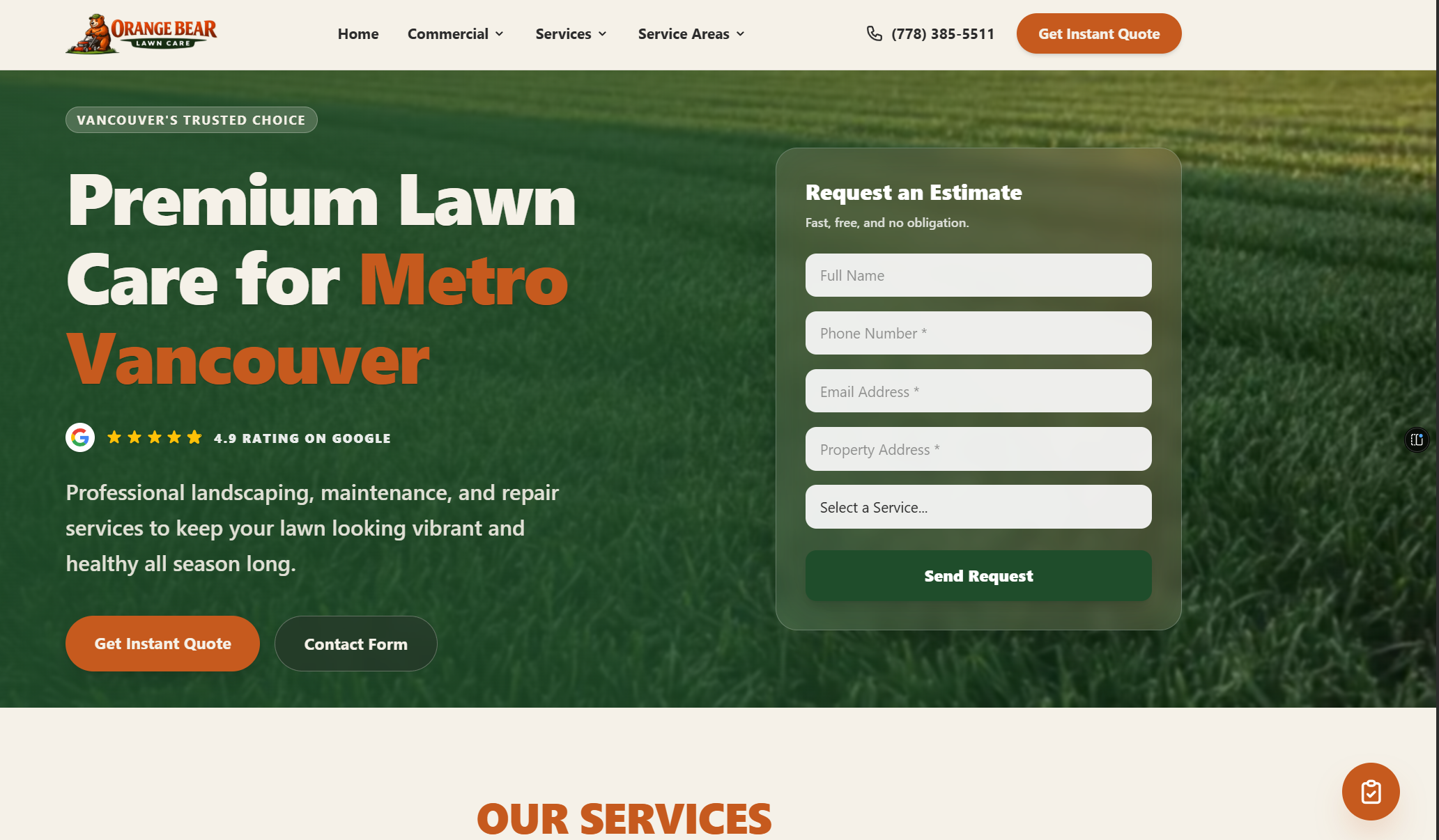
We built a website with dynamic seasonal logic — the home page shifts offerings, hero visuals, and CTAs by time of year. Google Ads run on a seasonally paced budget plan with distinct campaigns for spring work, mowing service, fall cleanup, and winter prep. Retargeting pulls customers back across seasons.
The Outcome
In the first full year, peak-season leads climbed to over 150 per month. The seasonality lift — the performance gap between off-season and peak-season — improved 60 % because off-season was stabilized through targeted campaigns. ROAS sits steady at 5.8× across the full year.
Note: Metrics illustrate typical project outcomes. Concrete numbers vary by starting point and target market.
Starting point: seasonality without a strategy
Orange Bear Lawn Care offers garden care, mowing, hedge trimming, and seasonal cleanup services in the Vancouver region. Like most landscaping businesses, the company fights a brutal seasonal curve: March through October is peak with overflowing capacity, November through February is off-season with revenue drops of up to 80 %.
The old digital presence ignored that pattern entirely. The site showed the same spring offers in December as in April. Google Ads ran on flat budget across all months — the result was May click costs through the roof and January spend evaporating.
Strategy: bake seasonal logic into site and campaigns
The fix wasn’t “more marketing” — it was “properly paced marketing.”
Dynamic website. The new site automatically shifts its core message by time of year. In spring, “Spring Cleanup” and “Lawn Startup” dominate; summer runs mowing subscriptions and irrigation; fall pushes leaf removal and winter prep. Same URL, context-relevant content — which lifts both conversion and SEO signals across the year.
Seasonally orchestrated Google Ads. The annual budget plan was split into four blocks with their own campaigns, budgets, and targets. Spring block drives volume aggressively, summer block focuses on retention, fall block sells packages, winter block retargets existing customers.
Retargeting layer. Customers who booked in summer see a matched follow-up campaign in fall. Customers who booked a fall cleanup get a personalized spring offer. This retention layer is why the off-season stopped collapsing.
Outcome: predictable business instead of seasonal chaos
The first full year on the new structure changed the business mechanics. In peak season, qualified leads land consistently above 150 per month — a level the business used to hit only in spike months. The seasonality lift — the performance gap between off-season and peak-season — improved 60 %, because off-season is no longer treated as “waiting for spring” but as a standalone acquisition phase.
ROAS holds at 5.8× across the full year — a robust average that comes from combining peak-season efficiency with off-season stability. The business didn’t just get bigger; it got more predictable. Hiring, vehicle purchases, and investments can now be planned seriously with twelve months of lead time.
Ready for a similar outcome?
We analyze where you are today and show you exactly how the same levers apply to you.
Book a free consultation