
King's Land Siding
Precise Google Ads strategy and a high-converting site: cost per lead cut by 45 % and 200+ qualified inquiries per month.
Measurable Results
The Challenge
King's Land Siding had a structural advertising problem: Google Ads were running, but cost per lead was twice the industry norm. Poorly segmented campaigns, a generic landing page, and undifferentiated ad creative drove plenty of clicks and few closes.
Our Solution
We rebuilt the entire ad architecture: tight keyword clusters by customer intent, dedicated landing pages per campaign, and a refreshed ad format with clear trust signals. The new website acts as the unified conversion anchor — ads and organic traffic run on the same optimized infrastructure.
The Outcome
Cost per lead dropped 45 % within four months. Ad click-through rate climbed to 8.1 %, well above the industry average, and monthly qualified leads settled consistently above 200. Ad budget stayed flat — the results still doubled.
Note: Metrics illustrate typical project outcomes. Concrete numbers vary by starting point and target market.
Starting point: burning ad budget with no result
King’s Land Siding is a specialized siding contractor in Calgary focused on installation, repair, and renovation. The business had run Google Ads in-house, then handed them to a generalist agency. Both routes produced the same problem: clicks were expensive, lead quality was uneven, and return on ad spend barely justified the investment.
The website wasn’t the main issue, but part of it. A single home page had to absorb traffic from very different campaigns — new-construction prospects, renovation prospects, and emergency repairs all landed on the same page with the same message. Result: low conversion, high bounce, expensive leads.
Strategy: campaign-specific funnels
The rebuild followed one principle — every campaign gets its own funnel, from keyword to intake form.
Campaign architecture. Instead of three generic campaigns, we set up twelve cleanly separated campaigns, clustered by search intent and service type: new construction, renovation, emergency repair, insurance claim. Each cluster has its own keywords, its own ad copy, and a dedicated landing page.
Landing page design. Each landing page is tuned to its cluster. The emergency landing page leads straight into a short form with a time-based CTA. The renovation landing page shows more references, a process overview, and a more detailed form. The new-construction page leans into project galleries and architect-facing language.
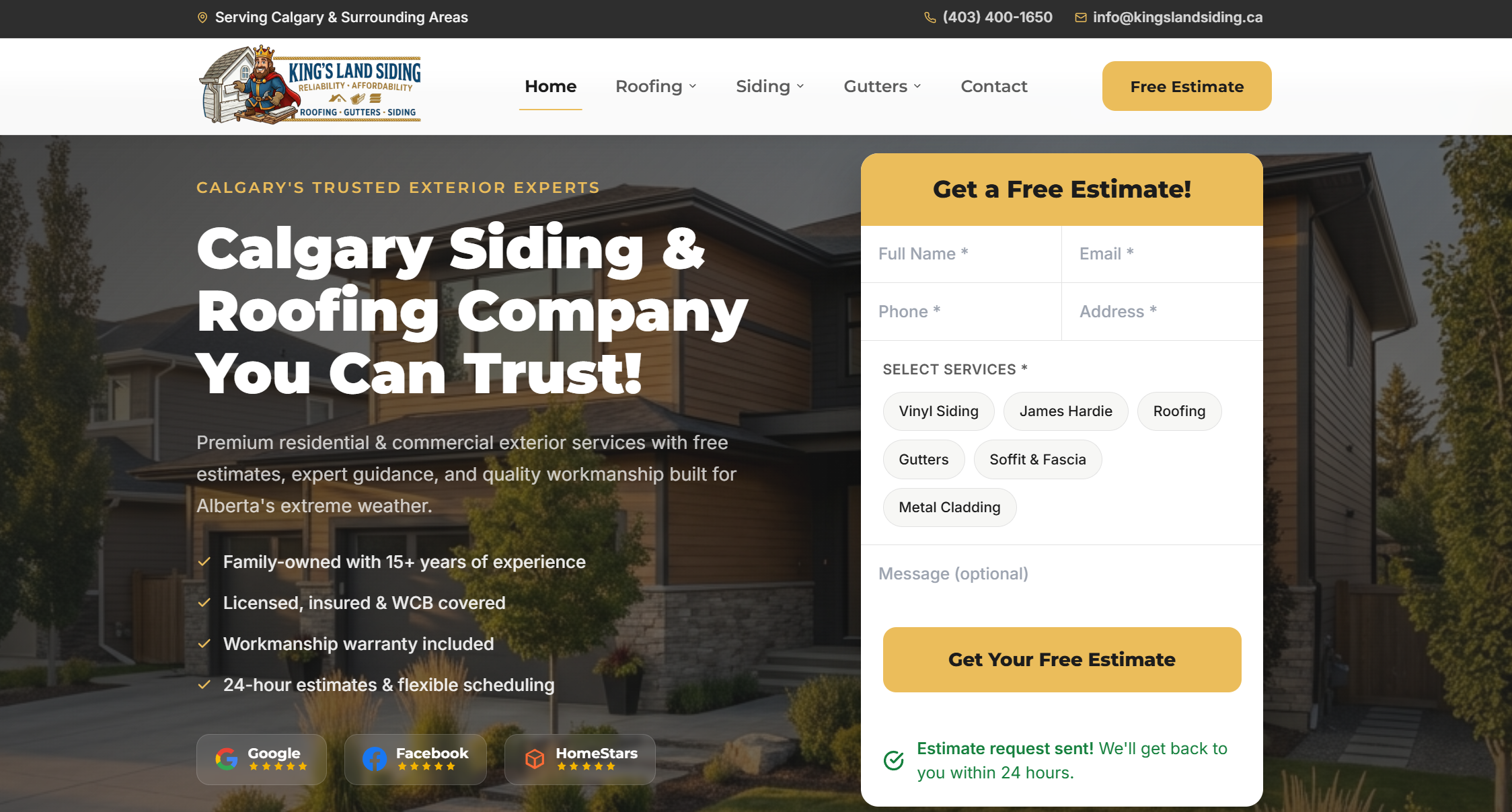
Website as conversion anchor. The new main site was built to pair consistently with the landing pages. Visual language, trust signals (Google reviews, BBB seal, warranty details), and contact paths are identical. A user who arrives via ads and wants to explore more finds the same visual signature everywhere.
Outcome: half the cost per lead, double the output
After four months, the core metrics had shifted entirely. Cost per lead fell 45 % — not because budget shrank, but because lead quality rose and close rates rewarded the ad mechanics. Click-through rate climbed to 8.1 % because the new copy matched search intent precisely. Qualified leads went from about 80 per month to over 200.
The durable effect is structural. Campaigns are now individually optimizable, landing pages are individually testable, and the full lead pipeline is transparent. Budget decisions run on hard data — no longer on gut feel.
Ready for a similar outcome?
We analyze where you are today and show you exactly how the same levers apply to you.
Book a free consultation